Monday, January 12, 2015

Romney should play kingmaker, not candidate

I like Mitt Romney. I think he's a decent human being who happens to be a terrible politician.

I was reading the Washington Post's excellent reporting (really, Robert Costa owns the Right, and no other reporter is in the same league, much less ballpark) on Romney, and I was struck by the closing.
Another GOP bundler received a phone message from Romney on Monday in which he said, “What you saw in the paper is true.” Romney added that he was giving “some consideration” to running again “for a lot of reasons.” Among the factors he cited: “I have a strong sense of duty.”
One could certainly have said that Romney's decision to run in 2012 was borne out of a sense of duty. The 2012 Republican field was the weakest of my lifetime. The only two good candidates on paper--Tim Pawlenty and Rick Perry--crashed and burned in devastating fashion. And a handful of viable Republicans with relevant experience--guys like John Thune, Mitch Daniels, and Bobby Jindal--opted out of running entirely. That left a field of also-rans. That field, without Mitt Romney, could have produced a true disaster for the party. Romney could have argued that he was needed.

But that is most clearly not the case for 2016, when Republicans have at least seven or eight particularly strong candidates. Two in particular stand out.

- Marco Rubio, the junior senator from Florida, is a wonderful speaker and has a great backstory. He has also engaged with domestic policy issues moreso than most senators, embracing the ideas of thoughtful "reform conservatives" like Yuval Levin and Ramesh Ponnuru. On paper, Rubio is a star.
- Scott Walker, the second-term governor from Wisconsin, is a less compelling speaker than Rubio, but his stylistic contrast from Obama--a move, let's say, from sizzle to steak--could be exactly what the country wants in 2016. Walker has gone through the "fire" three times, winning in Wisconsin while taking on the entrenched teacher's union and a robust, powerful Democratic machine. Walker is basically The Man, when it comes to getting things done on the right.

The truth is that both Rubio and Walker would be impressive nominees. I have my own biases towards governors, so for now, I would support Walker over Rubio. But they are far stronger candidates than Romney.

Meanwhile, Romney's negatives remain substantial. He has had two bites at the apple and lost both times. His unfavorable ratings exceed his favorable ratings. He doesn't speak conservatism as a first language, so he often ties himself into a pretzel while making conservative arguments. His major policy accomplishment as governor was the health care plan that Republicans are desperate to destroy. He is largely distrusted by the base. He'll be 69 years old in 2017, throwing away an obvious opportunity to showcase youth and vigor against Hillary Clinton, who has been in national politics for what feels like forever.

In 2012, Romney may well have been the indispensable man for the party. But in 2016, he is clearly not.

Romney and his supporters may argue that only his network and his resources can defeat Jeb Bush and then Hillary Clinton. This may be true. This, however, neglects the role that Romney himself can play: he can throw his support, immediately, to one of Rubio or Walker. An endorsement from party heavyweight Mitt Romney would make a huge difference. It would legitimate a so-called "second tier" candidate. It would help direct some of Romney's donors. Moreover, Romney is rich. He could use his own considerable personal wealth to fund a SuperPAC on their behalf.

If Romney really feels a sense of duty to the party and country, he should pick one of these two candidates to back. He could easily win a spot as Secretary of the Treasury, or Secretary of Commerce, or domestic policy chief, or any other high-profile position. It's not president, but if his goal is actually to win, it's a much better option. But it doesn't seem like that's his goal.

Thursday, January 8, 2015

One More Thing on Chris Christie

I've been saying for almost a year that I think Christie is a longshot at best for the nomination; in fact, I've used "doomed" as my word of choice, and I still believe that. Two prominent commentators--Nate Silver and Larry Sabato--have offered related thoughts. Yet both have focused on the Christie/Cowboys thing as a negative, to some extent at least. Sabato writes,

Christie’s over-the-top performance in Jerry Jones’ box last weekend, with his bear-hugging of Jones and his jumping up and down while squealing like a schoolgirl, infuriated and disgusted millions (our considered estimate). Still, it would be probably unwise, though somewhat just, to take out the nation’s massive dislike of the Dallas Cowboys on Christie. Yet Christie’s demonstrated aversion to Detroit, and his snubbing of New Jersey-area home teams, may earn him the voters’ rebuke in the Lions’ Michigan, the Giants’ and Jets’ New York, and the Eagles’ Pennsylvania.
Sabato is being tongue-in-cheek here, but there's a kernel of truth to it, I think, at least from his perspective, if I'm reading it right. Silver is more serious, writing,
So, what to make of something like Christie having been spotted in a luxury box in Arlington, Texas, on Sunday, where he joined Dallas Cowboys owner Jerry Jones ­­to watch the Cowboys’ 24-20 comeback win over the Detroit Lions? (Unlike certain politicians, Christie doesn’t seem to have mastered the art of rooting for a team from a swing state.) It seemed like a silly controversy until it was revealed that a company co-owned by the Cowboys was recently awarded a contract by the Port Authority of New York and New Jersey. 
Whether there’s actual impropriety or just the appearance of it, it was a dumb place for Christie to be seen if he’s contemplating a presidential bid. A presidential campaign is a long and mostly dull thing, and reporters chase down the serious and silly stories alike.
I have my own issues with Christie and the Cowboys, as I've written. But in terms of his chances at the nomination, I think that it doesn't hurt him, and might actually help him, marginally.

Although he is considered a frontrunner, Christie is best thought of as a longshot candidate. Frontrunners can sustain risk-averse strategies; in fact, they may well be the optimal ones. But longshot candidates have to do things that are risky. Christie's best argument at this stage may be something like "refreshing, radical authenticity." It is unlikely to resonate, but that does not mean that it is completely impossible. The governor of New Jersey rooting openly and loudly for the hated Dallas Cowboys could be taken as a sign of that authenticity. Jumping around like an idiot after the Cowboys clinched the win? Definitely authentic. What politician does that, ever?

To win the nomination, at a minimum, Christie needs a bunch of New Hampshireities to say, "Man, Christie's the guy I'd like to have a beer with!" Christie's not going to get votes via issue fidelity, or being the most conservative electable candidate in the very deep field. But he might get there by the sheer force of his personality, if it resonates.

Again, this is a low-likelihood play; Christie is severely disadvantaged by a bunch of things, at this point. But considering his position as a candidate, it is his best chance.

Christie should be himself.

Monday, January 5, 2015

On Chris Christie, the Dallas Cowboys, and Two Americas

As I watched the depressing end to a football game between the Lions and the Cowboys, I saw something that frustrated me more, from the perspective of an American, rather than as a bitter supporter of the New York Giants.


(photo from SBNation.com)

That's Chris Christie, the governor of the state of New Jersey, palling around with the very wealthy owner of the Dallas Cowboys, Jerry Jones, in the owner's suite at AT&T Stadium in Arlington, Texas. Christie claims to be a lifelong Cowboys fan, and I believe him when he says that. I also believe that his enjoyment of the game is genuine, and his jumping in on the hug was entirely normal. (Sports do this to people who really care about them. We jump up, hug, scream, and sometimes even cry, when exciting things happen. To mock someone for that is not really fair.)

So I have no qualms with Christie getting emotional about the Cowboys, or the Mets, or the Rangers, or whatever other sports teams he cares about. And if he wants to share his feelings about sports with us, I have no problem with that, either. (Frankly, I like Christie as a political figure, even if I am very unlikely to vote for him in the Republican primary in 2016. I think he's basically as good a governor as New Jersey will get, and the track record of governors of the state of New Jersey in my lifetime basically bears that out.)

What does bother me, though, is Christie in that owner's suite. (He even went to the locker room after the game.) If Chris Christie were just a regular old attorney in the state of New Jersey pulling in $175,000 a year, there is zero chance that he would ever be in that booth. As governor, though, he has access to situations that he would not be able to get in another line of work.

One of my major objections to politicians these days is that they often take liberties and receive perks that ordinary people cannot even imagine. I see three different categories where this happens, but they are closely related.

1. Politicians hobnob with celebrities, athletes, and other so-called very important people.

Christie is particularly guilty of this, in my judgment. But he's not alone. President Obama is friends with Jay-Z. John Boehner once offered Billy Joel a cigarette. Half of the Democratic Party has spent time with Bruce Springsteen (as has Christie, post-Sandy).

I know that this is the expectation these days, as athletes who win championships visit the White House as a matter of course. But I am asking for us to use a more modest standard. Presidents and politicians can have social lives, but why must they be with famous musicians and actors?

These encounters privilege both the celebrities and the politicians. We would be better off if we stopped offering our tacit approval. 

2. In traveling on campaigns and for fundraisers, security standards result in massive inconveniences for ordinary folks.

Joe Biden's vice presidential motorcade closed the Lincoln Tunnel, New Jersey Turnpike, and Interstate-280 for a fundraiser for Jon Corzine in 2009. In Portland, OR, Biden's campaigning--and some basic planning errors--resulted in the near-total shutdown of the all-important TriMet light rail system.

We see this with lesser VIPs, with teams getting disruptive state police motorcades between hotels and stadiums.

Security concerns are what they are. But there is a line between prudence and disruption. Frankly, "security at any cost!" is not a realistic standard. Hiding in plain sight, in a nondescript car on a highway with an armed guard or two, covers most potential security risks. If a low probability thing like a fatal car accident--or even a planned assault--happens, that is an incredible tragedy. But the country will survive it, and has survived worse. No single politician--besides maybe the president--is so indispensable that citizens should accept massive dislocation so that said politician can get to a fundraiser. The single parent who gets stuck in traffic and has to pay an extra hour to the babysitter does not deserve that. Nor, for that matter, does the person who simply wants to get home to watch Jeopardy, or Monday Night Football, or The Big Bang Theory.

3. As much as we try to avoid it, we see the well-connected avoid prosecution, even in cases where the law is clear.

There was a minor story on the Right a couple of years ago, when David Gregory, then-host of Meet the Press, exhibited a high-capacity gun magazine on his program. Possessing the magazine was illegal in the District of Columbia, where the show was taped. Pretty clear violation, no? Not exactly:
NBC’s David Gregory is off the hook for showing a high-capacity gun magazine on “Meet the Press” and will not be prosecuted, D.C.’s attorney general announced on Friday. 
D.C. attorney general Irvin Nathan on Friday said he would decline to prosecute in the case involving the Sunday show host and any NBC staffers. In a letter to NBC’s attorney Lee Levine, Nathan wrote that after reviewing the matter, his office “has determined to exercise its prosecutorial discretion to decline to bring criminal charges against Mr. Gregory, who has no criminal record, or any other NBC employee based on the events associated” with the broadcast.
The Right blasted the hypocrisy and demanded Gregory's prosecution. If we take a step back, though, it seems pretty clear that Gregory was not violating the spirit of the law, and that the clemency he was shown was a good thing, in terms of justice.

Meanwhile, Shaneen Allen, a law-abiding gun owner from Pennsylvania, acknowledged having a gun in her car during a routine traffic stop in New Jersey. Possessing the gun, unfortunately, violated NJ's gun control laws. After a threatened prison term, a public outcry, and almost a full year in legal limbo, the charges were dropped. But it wasn't like with Gregory, who immediately got the benefit of the doubt from the justice system. Gregory is part of the elite, and Allen is not.

We see this all the time with well-connected people. Drug offenders who are politicians (or related to politicians) get clemency, or suspended sentences, or rehab. Minorities get jail time.

As commentator Sean Davis wrote, in the aftermath of the Eric Garner grand jury decision:
John Edwards was right: there are Two Americas. There’s an America where people who kill for no legitimate reason are held to account, and there’s an America where homicide isn’t really a big deal as long as you play for the right team. 
Unfortunately Eric Garner was a victim in the second America, where some homicides are apparently less equal than others.
In the case of Garner, the police officer gained the benefits of being in the right America. Politicians are in that America. The well-connected in general--and politicians in particular--exploit their status to gain personal benefits that are not available to ordinary people. It is one thing when a rich person spends their money to gain great benefit; it is quite another when a politician gains the trappings of wealth simply because of their elected position.

We cannot stop all of these incidents. But we should be vociferously critical when politicians use their political positions for their own benefit, rather than for the benefit of their constituents. We elect politicians as leaders, but they are ultimately servants in our republic. Ideally, at the end of their terms, they'd quietly return to their farms. We are the bosses. We're not electing them to hang out with the Dallas Cowboys.

If Chris Christie wants to watch the Cowboys, he should do it at home with his family, or with friends, or in a bar, or by himself, just like the rest of us. I fully support him in that. He can jump around and hug whomever he wants. But if he wants to go to the game, he should buy a ticket.

Wednesday, November 5, 2014

Your Majority Party is Doomed

Congratulations! Your political party has won control of the vital levers of American government. Presumably, your party was elected on a platform to solve several pressing challenges facing the country. Now it is time to govern.

You have two choices:

1. Govern badly, and voters will throw you and your party out, mercilessly.
2. Govern well, and you will solve the pressing problems that brought you to power. Over time, however, your agenda and message will become stale as voters develop new issues and concerns, and they will vote you out. This will happen more quickly than you expect.

Congratulations! Your opposition is crazy and/or inept. One of two things will happen:

1. They will grow irrelevant, making your party enormous. However, your party will fracture and split under the pressure of so many competing interests and views. Eventually, a new party will emerge, combining the ashes of your old opposition and the malcontents in your big party.
2. They will wise up, adjust their policiesnominate better candidates, and challenge your rule.

In American government, the majority party is doomed. It always was, and always will be.

Friday, October 24, 2014

Quick Thoughts on Ebola and Quarantine

As far as I can tell, to date, very few people are panicking about Ebola. Mollie Hemingway of The Federalist and Mark Hemingway of The Weekly Standard have done a pretty good job refuting this media-driven narrative of panic about Ebola. And some of us who would respond "yes" to questions about concern about an Ebola outbreak are worried for the sake of our friends and family members who work in medicine, rather than for ourselves.

(Also, poll respondents may be answering different questions than the ones being asked! But that's a different post.)

However, panic is not an impossibility. I think John McCormack is dead on:
In other words, we don't see panic until some random person catches Ebola on the subway by touching an infected surface and then scratching his/her eye. If that happens, panic and a larger economic impact--in addition to the actual human impact--becomes much more likely.

Moreover, the first secondary infection in the US is likely to be out and about for a longer period of time than our previous Ebola patients, because Ebola isn't going to come up on the medical questionnaires that the patients will be answering. (Have you recently traveled to West Africa? No? Probably the flu.) So, then you could see additional secondary infections off of that first secondary infection.

Let's be clear: thinking about this outcome does not keep me up at night; it is unlikely. But it is not outside of the realm of possibility.

Fortunately, we have a fairly straightforward way to prevent this: mandatory three-week quarantines for potential disease vectors. The most likely disease vectors for Ebola are not regular people from Liberia or Guinea or Sierra Leone. It's the health care workers who are returning home from those countries. These people are doing great work (some would say God's work), and they deserve our respect and gratitude. The likelihood of something very bad happening because we do not compel quarantine is very small, but the cost of doing what it takes to prevent that very bad outcome is so small that to risk the very bad outcome doesn't make sense. The calculation here is fairly straightforward; mandatory quarantines for 21-days are low cost, and their likely effectiveness at preventing secondary infection is extremely high.**

If we're concerned about the unfairness of quarantine, as Sarah Kliff of Vox.com is, we can offer compensation for medical volunteers forced into quarantine. And frankly, it's three weeks out of their lives in 2014, the age of Netflix, tablets, e-Readers, and smartphones. The quarantined people might become stir crazy, but this isn't cruelty, if managed correctly. (We may well want to provide bonuses for doctors traveling to these areas to treat this epidemic, anyway. It strikes me as a worthy expenditure of tax dollars.)

One final note: we are doing a pretty darn good job treating Ebola patients in the US, which has led some experts to suggest that the mortality rate on Ebola with effective treatment would be closer to 10 or 20 percent. But this is very likely because of the quality of medical attention we have been able to provide the handful of patients that we have dealt with. If Ebola becomes more common in the US, the level of attention will drop, and it is likely that the mortality rate will rise. If we're dealing with more than a handful of cases, we can't get every Ebola patient to Emory, Omaha, or the National Institute of Health.

**This sort of cost/benefit calculation is why one can support this sort of prophylaxis against Ebola while rejecting current proposed prophylaxis against global warming.

Wednesday, October 15, 2014

Ebola and Organizational Behavior

Graham Allison's Essence of Decision is a remarkable book with almost universally applicable insights. I don't own the book, but enough of Allison's writing is available online to cite usefully here. I'll be pulling various quotes from a 1968 article by Allison, currently located at the RAND Corporation's site.

If you can't get around to reading the book, the paper seems worthwhile.

Let me summarize the key points of Allison's organizational process model, as I understand them:

  • Organizations are designed to be able to coordinate the actions of multiple people to accomplish things that would not be able to be done independently.
  • Organizations are very often blunt instruments: they rely on standard procedures, whether explicated or implicit.
  • In approaching new problems, they tend to look for similarities to older problems, and often act by analogy.
  • Those procedures and organizational habits are very difficult to supplant, though it can be done in limited cases.

Feel free to skip ahead to Organizational Behavior and Ebola Treatment if you're not interested in Graham Allison; I provide a bit more context for that summary in the next few paragraphs.

Allison's Essence of Decision looks at the Cuban Missile Crisis through three lenses: the rational actor model, in which governments make decisions like chess players; the bureaucratic political model, in which government decisions are driven by institutional positioning and self-interest; and the organizational process model, in which the capabilities of organizations govern government decision-making. Allison demonstrates that all three models are useful for analysis, but it largely serves as a corrective for analysis that relies entirely on the rational actor model. If you're not thinking about bureaucratic politics or organizational behavior when you're analyzing decision-making, you're missing a ton of texture.

For my purposes today, the organizational process model is the most useful. Allison points out that part of the way that the US detected the missiles in Cuba was because Soviet soldiers had put red stars on their buildings that were visible from their roofs; it was standard operating procedure to do so at a Soviet site. (Another example: the spy satellites saw soccer fields. Russians played soccer; Cubans played baseball. A really good deception program would have accounted for that, but organizational behavior was what it was.)

On organizational capabilities, Allison writes,
Many organizations must be capable of performing actions in which the behavior of hundreds of individuals is carefully coordinated. Assured performance requires clusters of established, rehearsed standard operating procedures for producing specific actions, e.g., fighting enemy units or constructing military installations. Each cluster comprises a "program"... which the organization has available for dealing with a situation. The list of programs relevant to a type of activity, e.g., fighting, constitutes and organization repertoire. The numbers of programs in a repertoire is always quite limited. When properly triggered, organizations execute programs; programs cannot be substantially changed in a particular situation. The more complex the action and the greater the number of individuals involved, the more important are programs and repertoires as determinants of organizational behavior.
He continues,
Where situations cannot be construed as standard, organizations engage in search. The style of search, and the solution in any particular case are largely determined by existing routines. Organizational search for alternative courses of action is problem-oriented: it focuses on the atypical discomfort which must be avoided. It is simple-minded: the neighborhood of the symptom is searched first; then, the neighborhood of the current alternative. Patterns of search reveal biases which reflect special training or experience of various parts of the organization, expectations, and communication distortions.
Lastly, Allison wrote, "Government leaders can intervene and disturb organizational propensities and routines. Central direction and persistent control of organizational activity, however, is not possible." Allison was writing about government, but really, we're talking about the impact of an external force on an entrenched organization via coercion, cajoling, etc.

Organizational Behavior and Ebola Treatment

So, we know that organizations can have strong capabilities, but they also have severe limitations.

Let me pose my theory of what happened at Texas Presbyterian Hospital, from a Graham Allison-organizational process perspective.

A patient who claims to have been to West Africa comes in with symptoms resembling a bad virus. He has a very high fever, but people really haven't been paying much attention to the news, and they're not inclined to think hemorrhagic fever unless the patient is... you know, hemorrhaging from the eyes, vomiting blood, etc. So they assume "sinusitis" and send him home with antibiotics, just in case it was bacterial.

Personal aside: I was once hospitalized with sinusitis. This wasn't an unreasonable diagnosis, based on the symptoms. I felt like death, had a very high fever, and ended up spending five nights in the hospital. Sickest I've ever been.

Two days later, he comes back, obviously very sick. They're now thinking Ebola, and they got the diagnosis right.

Hospitals use "standard precautions" in dealing with infections to avoid sickness, as well as to avoid spreading infections between patients. (See the sad case of Ignac Semmelweis and puerperal fever for their importance.)

Hospital workers and administrators know that Ebola is serious, but they also know that they have "standard precautions" to follow. The initial thinking is that the precautions will work, provided that they're careful. They work, after all, on the most comparable virus we know about: HIV. And on a gut level, the two are similar: they are not airborne, thankfully. They are spread through contact with bodily fluids. And they are very serious.

This was the first error, though. While HIV and Ebola are comparable on a surface level, there are some significant differences. Ebola is actually more contagious; HIV does not survive outside of the body for longer than minutes, but Ebola can survive on surfaces for much, much longer. (Believe it or not, most people catch the flu the same way they could, in theory, catch Ebola: contact with infected surfaces and then putting their fingers in their mouth, or nose, or eyes. The flu is airborne, but it's really the contact with surfaces that causes most cases, if I understand it correctly.)

Moreover, while HIV destroys the immune system, Ebola overwhelms the entire body. A late-stage HIV patient is most vulnerable to an opportunistic infection that a person with a fully-functioning immune system would fight off. Ebola just reproduces and reproduces until the body basically excretes it from all points of exit.

The HIV analogy is not good enough.... but the procedures come from the HIV analogy.

This basically seems to be what happened. The Dallas Morning News writes:
The 3-day window of Sept. 28-30 is now being targeted by investigators for the Centers for Disease Control and Prevention as the key time during which health care workers may have been exposed to the deadly virus by Duncan, who died Oct. 8 from the disease. 
Duncan was suspected of having Ebola when he was admitted to a hospital isolation unit Sept. 28, and he developed projectile vomiting and explosive diarrhea later that day, according to medical records his family turned over to The Associated Press. 
But workers at Texas Health Presbyterian Hospital Dallas did not abandon their gowns and scrubs for hazmat suits until tests came back positive for Ebola about 2 p.m. on Sept. 30, according to details of the records released by AP.
Seems like standard precautions were in place, rather than biohazard level 4 precautions, as Ebola really warrants.

Now we're hoping for luck. Not only are the health care workers at risk, but other patients in the hospital that the health care workers dealt with are also at risk.

The story continues. They eventually realized that standard precautions were not enough, so they started putting on more gear. But it appears that there was a failure in training, or just flat inexperience; US hospitals do not deal with this level of infection. Most really sick people in hospitals have cancer or organ failure, not infectious disease. That's a good thing, but it means that organizations don't really know how to handle those cases that do emerge.

As the patient got sicker, the hospital implemented standard operating procedures for critical care. I'm not a health professional, but I assume it's something like this:

- Able-bodied man's kidney's start to fail? Get him on dialysis.
- Airway obstructed/breathing problems? Tracheal intubation.

With a late-stage Ebola patient, these procedures are incredibly dangerous. The later into the disease a patient is, the more contagious they are. But these are the standard operating procedures in critical care, and this is what the hospital implemented.

So we had a systemic, procedural failure at Texas Presbyterian, brought about by procedures that were not equipped to deal with the nature of the problem they faced. Note that this problem isn't even remotely due to the activities of health care workers. They were implementing procedures. It is the job of management to ensure that procedures make sense for the circumstances that line workers face.

What should be done going forward?

Only the government could have changed these procedures. It was never something that a conventional hospital was going to be able to handle. That's the critical failure here; the workers at Texas Presbyterian were left out in the cold, when they actually would have required some assistance from our medical establishment.

First and foremost, Thomas Frieden should be fired at the end of this crisis. He is just now striking the right chord, in terms of what hospitals should be thinking with Ebola. But for weeks, he has downplayed the risks faced by American health care professionals. When Frieden says, "One of thing we want to emphasize is virtually any hospital in the country that can do isolation can do isolation for Ebola," that's a signal to hospitals that this isn't a big deal. Over and over, literally for months, we have heard that "Western infection controls" should be able to stop Ebola. We haven't heard the necessary message: that Ebola is extremely dangerous, and is very contagious in late stages, and that health care workers are very much at risk.

Moreover, this isn't just a messaging problem. CDC hasn't been taking it seriously enough, if a nurse involved in the treatment of Thomas Duncan was allowed to fly before the end of the incubation period. They genuinely do not seem to have a grasp of the risk of what they are dealing with. It is classic overconfidence.

In general, this "everybody be calm!" message has been coming from every official we've heard from, presumably to prevent a panic. This backfires, though, when the reassurances prove wrong; people become (rightfully) skeptical of what they hear from those officials. And frankly, there are worse outcomes that a few people panicking.

Next, we really do need to step up procedures for decontamination, and we need to roll out a lot more training on it, fast. It is possible that we're going to see more cases, maybe even enough to swamp our ability to send CDC teams out to handle treatment.

Additionally, we may need to consider restricting critical care procedures. If someone is so sick from Ebola that they need kidney dialysis, we just may not be able to provide the care in a way that will keep our medical professionals safe. This is a sad potential reality, but it may well be true. For severe Ebola cases that do not show signs of improvement, we may need to shift to palliative care rather than our era's preferred model of heroic medicine. I am not an expert on the subject, but I hope that someone, somewhere, is having this conversation.

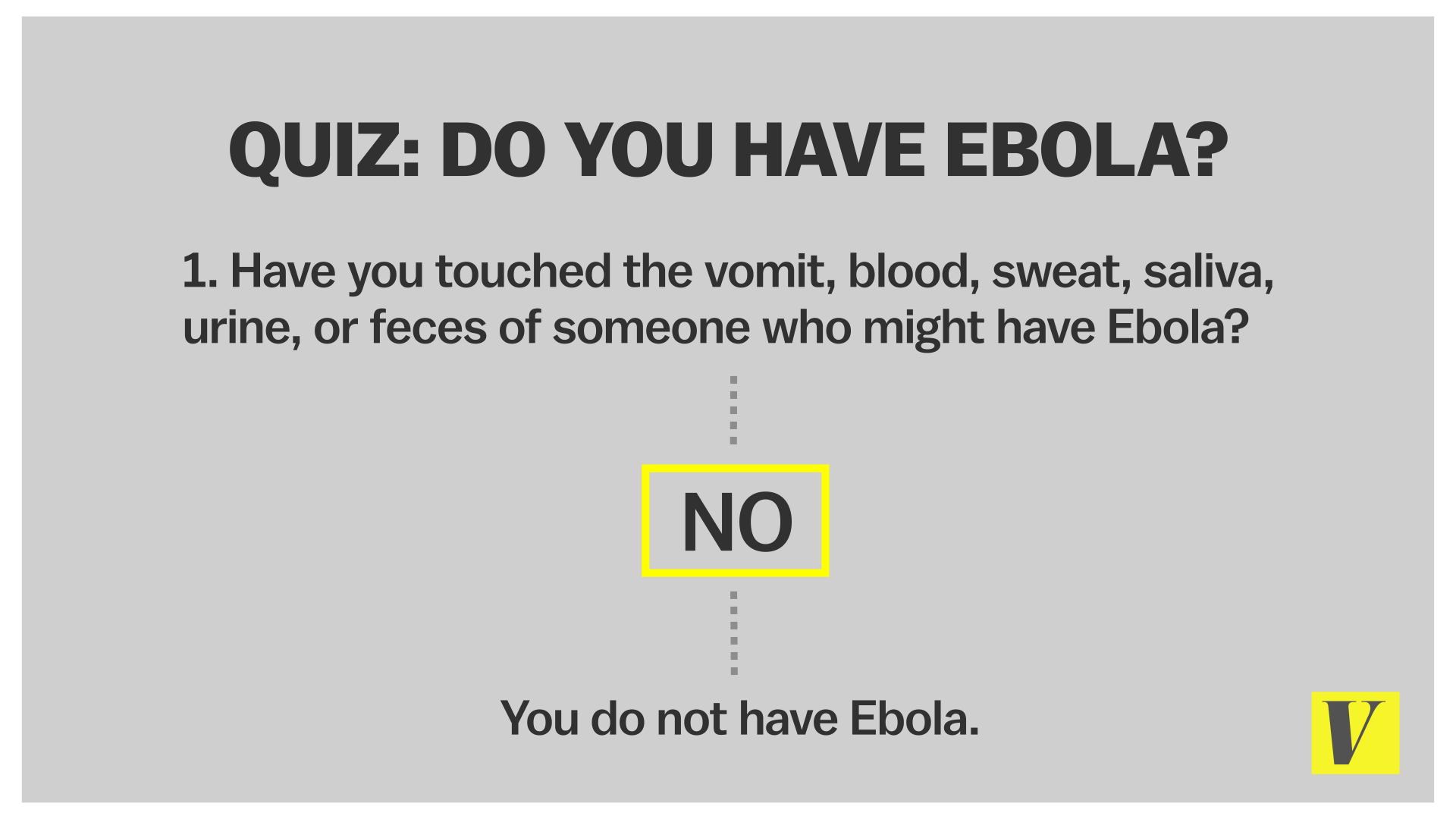
Lastly, people need to stop mocking those who are worrying about Ebola. Vox.com, voice of the glib Left-leaning establishment, put out a graphic like this a few days ago:


This glib approach is so, so bad. It signals to people that they don't have to worry. But they should worry, at least a little bit.

Part of why we haven't been wiped out by something like Ebola is because people who appropriately worry about things have acted appropriately. It's the same thing with the notion of the "arc of history" or whatever. Human action shapes the arc. It's not just something that happens, and assuming that the "arc" will carry us to where we want to go is just incredibly naive.

The "go team" approach is the right one, because CDC specialists will have a better chance of implementing the proper procedures for infection control. But, again, this is too late for the health care workers who are now at risk. And they were utterly, utterly failed by a hubristic establishment. Chris Hayes, correct again.

Sunday, August 10, 2014

Conservative and Progressive Approaches: Flaws, Solutions

(Part 1 of this post available here.)

Conservatives have a lot of good instincts, I'd say. But really, the progressive instinct is the better one.

Even as a conservative, I believe that. Why shouldn't we admire those of us who see oppression and demand its end? Not everyone does. I daresay the average person is not a progressive; it takes a certain disposition to the world to identify oppression, particularly when you come from a position of privilege, as many white progressives do. As a non-progressive, this stuns me: many progressives grow up in a position of wealth, with their parents making six figures and living in a safe neighborhood with great schools. The world is their proverbial oyster; they are some of the wealthiest people in the history of mankind. But they don't cling to their comfortable lives. They insist that we can make the world better for other people, even at cost to themselves.**

Or look at once-disadvantaged progressives. Many have pulled themselves up from incredibly difficult circumstances. But they can't take... perhaps the obvious advice: don't look back. They must look back; they care too much about where they come from.

Or the still-disadvantaged progressives. A thoughtful progressive who grew up in poverty and remains in poverty, but still has the passion to agitate, to challenge, and to think about the structures of inequality is doing something remarkable. It would be perfectly reasonable to drop out of the political conversation altogether, or to lose hope in our ability to improve the world around us. But they do not.

These are good, decent, kind-hearted people. It is unfortunate that many conservatives do not seem to share this instinct for seeing oppression and desperately wanting to root it out. For me personally, that is not a natural way of thinking, as a conservative; I see the need for charity, but I have to work to see structures of oppression, even though I am pretty well convinced that they exist. And I see it is a weakness in conservative thought.

So, why am I not a progressive? Because that instinct about oppression is good and important, but it's not enough.

Conservatism is a series of balancing tests, essentially, as its practitioners grapple with living in complex, hard world. Its foundational principle, above all, is that people are flawed, and that institutional structures and habits are the best way to prevent those flaws from swallowing society. It is, when practiced right, a philosophy of humility: humility about what we can and cannot know, humility about what we can and cannot do, and humility about we can and cannot see. Conservatives have goals, but their adherence to process inevitably limits what they can accomplish. And this is, by and large, a good thing.

Progressivism, on the other hand, recognizes few, if any, limits, in seeking its goals. It will go to any practical length in its quest for social justice. It must immanentize the eschaton. But it charges boldly into a world that it cannot understand--that we cannot understand. It is the proverbial bull-in-the-china-shop in public policy. Even if the bull came in because it wanted to buy crockery, it's still going to cause damage.

Ultimately, its flaw is in its lack of humility: the structures that conservatives support are built to protect us from ourselves and our own weaknesses. But progressivism, in its triumphant view of what can and must be done, simply has no room for that posture, and all-too-human failings--pride, hubris, greed, corruption--sink its good and decent intentions. While conservatives are just as guilty of those human failings, their ideology accounts for them. Progressivism does not; it wishes for better men and better women in positions of power and influence, but it never gets them.

And so it always seems to fall short; its governments simply cannot do what it asks of them. Its social problems are more intractable than anticipated. Its solutions often cause unintended consequences that cascade far beyond what could have been reasonably anticipated. (And, in the ultimate irony, the structures it sets up to solve problems become the most conservative institutions in the world: stagnant, collectively-bargained government agencies.)

My "solution," such that it exists for these flaws, is fairly simple: in an ideal world, progressives would set the agenda, and conservatives would drive policymaking and governance. If conservatives were compelled to generate policy solutions to solve the various problems that progressives identify, the solutions would be significantly better than what we get today. But conservatives have squandered those opportunities, and when progressives attempt to borrow conservative ideas, they do so clumsily and without an understanding of core conservative insights. (Moreover, such a setup does not fit in with our model of government.)

I suppose that I would be more willing to entertain progressivism if it accepted precautionary limits on power when it was in power. But I'm not holding my breath.

**I have less sympathy for the "limousine progressive" who would refuse to sacrifice anything themselves for their progressive aims. But I'll be charitable and suggest that this is a small minority of an otherwise-honorable population.